Roughly 40 Acres Near Lawrencetown Beach for Sale, Raises Concerns Over Trails
A 39.9-acre parcel near Lawrencetown Beach, long used as a hiking trail, is listed for $7.5 million, stirring debate over development and nature preservation in Nova Scotia amid housing policy changes.
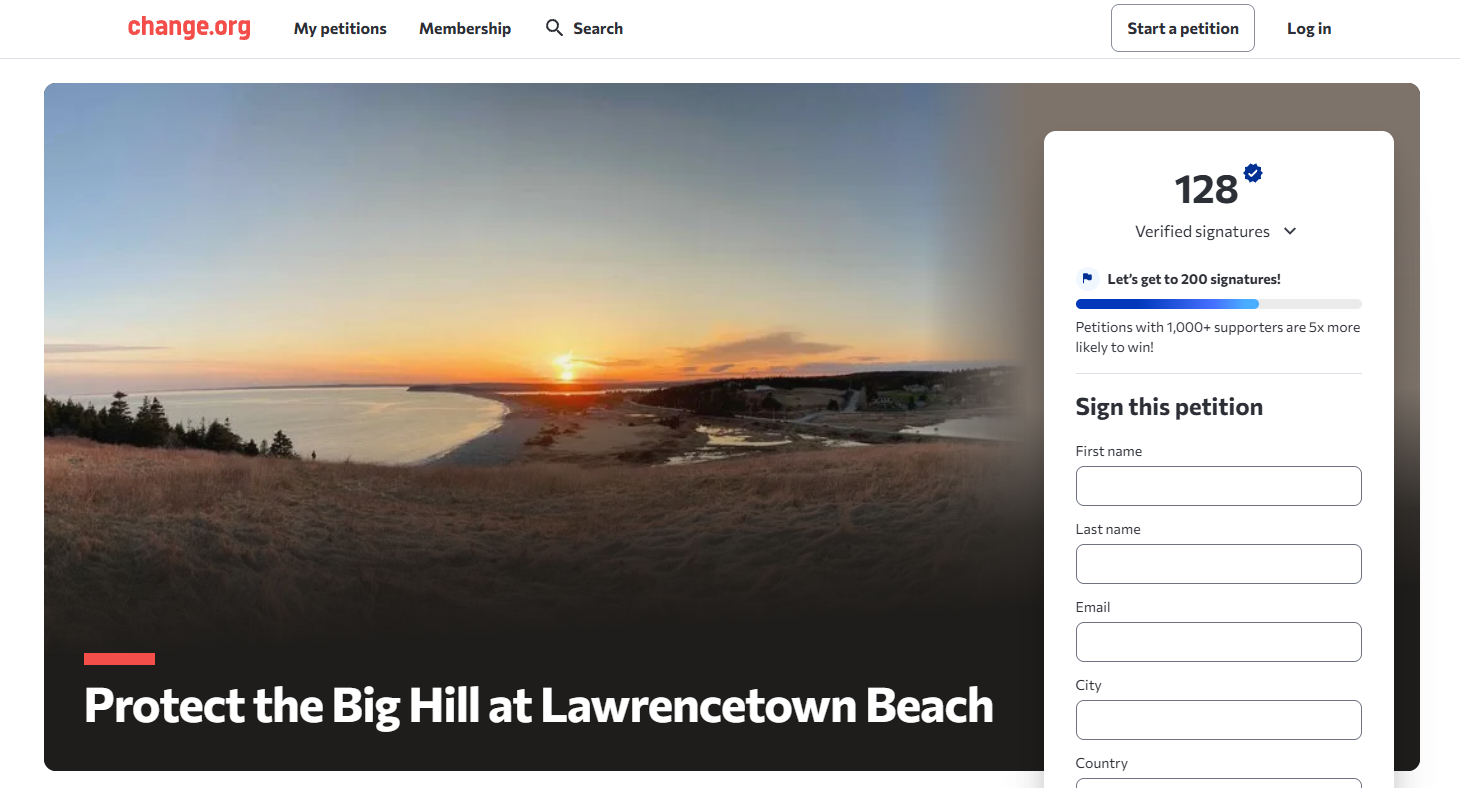
File photo — Change.org petition titled “Protect the Big Hill at Lawrencetown Beach” · Photo: Source not provided · Editorial image (licence not claimed) · Original image source
A large stretch of coastal land overlooking Lawrencetown Beach is up for sale, and people who have spent years hiking its trails are pushing to have it protected before a buyer decides what happens next.
The property, listed as Lands 207 Highway in East Lawrencetown, covers approximately 40 acres and carries an asking price of $7.5 million. The listing, MLS 202626133, is represented by Sandy McDonald of EXP Realty of Canada Inc.
The land sits beside one of Nova Scotia's best-known surfing beaches. Its wooded trails and coastal terrain have attracted walkers, dog owners, birdwatchers and surfers for years, despite the property being privately owned. That distinction matters now.
A petition titled Protect the Big Hill at Lawrencetown Beach is asking the provincial government to help purchase the property for conservation rather than leave its future entirely to the real estate market. The petition's organizer, Amy Debaie, a local nurse who describes regularly walking the trails, says many people in the area had assumed the hill was Crown land.
The campaign asks Nova Scotia to work with the Nova Scotia Nature Trust and the Nature Conservancy of Canada to acquire the property and bring it into the Cole Harbour–Lawrencetown Coastal Heritage Park System.
It's a proposal for a purchase, not a demand that the land be taken from its owner. The petition acknowledges the owner's right to sell and argues that conservation organizations should have an opportunity to make an offer.
- A development opportunity, but for what?
The property listing promotes the land as a possible private retreat, long-term investment or future development opportunity, subject to zoning and approvals.
There is one notable inconsistency: the listing records the lot size as 399.0482 acres, but its written description refers to approximately 40 acres of oceanfront land. The difference warrants clarification from the listing agent, although it is an obvious typo, as there is another ~40-acre parcel nearby priced at $600k, which is roughly the same size on maps. Why is this parcel over 10x the price while assessments remain low on it? A question only the seller can answer. We have reached out to the seller for comment and have not received a response at the time of publishing.
No approved development proposal has been established in the available information, and a sale would not automatically mean the land is cleared or subdivided.
Still, the listing arrives while Halifax and the surrounding communities are under considerable pressure to accommodate more housing.
Provincial efforts to accelerate residential construction have changed how development is approved in parts of Halifax Regional Municipality. Those reforms are intended to increase supply, but there's no evidence that developing this particular coastal property would necessarily produce affordable homes. While these changes make it easier for developers to build more, they have also increased the cost of the very land aspiring homeowners want to buy, not helping affordability as intended.
The distinction between adding housing and making housing affordable is important.
A May 2026 Statistics Canada study found that 49.9 percent of millennials aged 25 to 39 who had moved out of their parents' homes owned their homes in 2021. The comparable figures were 56.2 percent for Generation X and 55.9 percent for baby boomers at the same age. We build more and more, yet affordability and homeownership among our newest generation is the lowest in recorded history.
Those are national, historical comparisons, not current Halifax housing figures. They nevertheless illustrate how access to homeownership has changed across generations, most likely due to steadily increasing home and land prices.
In Lawrencetown, the immediate question is different: whether a privately owned piece of coastline that people have long treated as a shared outdoor space can remain accessible.
- The price of keeping the trails
Conservation would require money, negotiations and a willing seller. The petition identifies the Crown Share Land Legacy Trust, which supports land conservation through revenues associated with offshore petroleum resources, as one potential funding avenue.
Whether the province or a conservation organization would consider purchasing this property has not been established.
There are also questions about the trails themselves. Longstanding recreational use does not automatically establish a legal right of public access. Without an agreement or some other protection, a future owner could potentially restrict entry. For people who use the hill regularly, that possibility is reason enough to act before the sale is completed.
At $7.5 million, preserving the property would be a substantial undertaking. But the petition has put a specific proposal on the table: give conservation buyers a chance to keep the land accessible rather than risk losing the trails to private ownership restrictions or future development.
What happens next depends on the seller, potential buyers and whether the province or a land conservation organization is prepared to get involved. You can find the petition here if you would like to get involved.