Global Markets Plunge as $2.5 Trillion Erased from US Stocks Amid AI Regulation Fears
On November 5, 2026, US stock markets plunged, with the Nasdaq Composite falling 5.5%, wiping out $2.5 trillion in value. This sharp decline reflects investor concerns about potential regulatory restrictions on artificial intelligence infrastructure following significant Democratic victories in the midterm elections. Semiconductor stocks were deeply affected, with Intel shares dropping 30% and the sector losing nearly $1 trillion in market capitalization. The sell-off extended globally, impacting major markets in Asia and Europe.
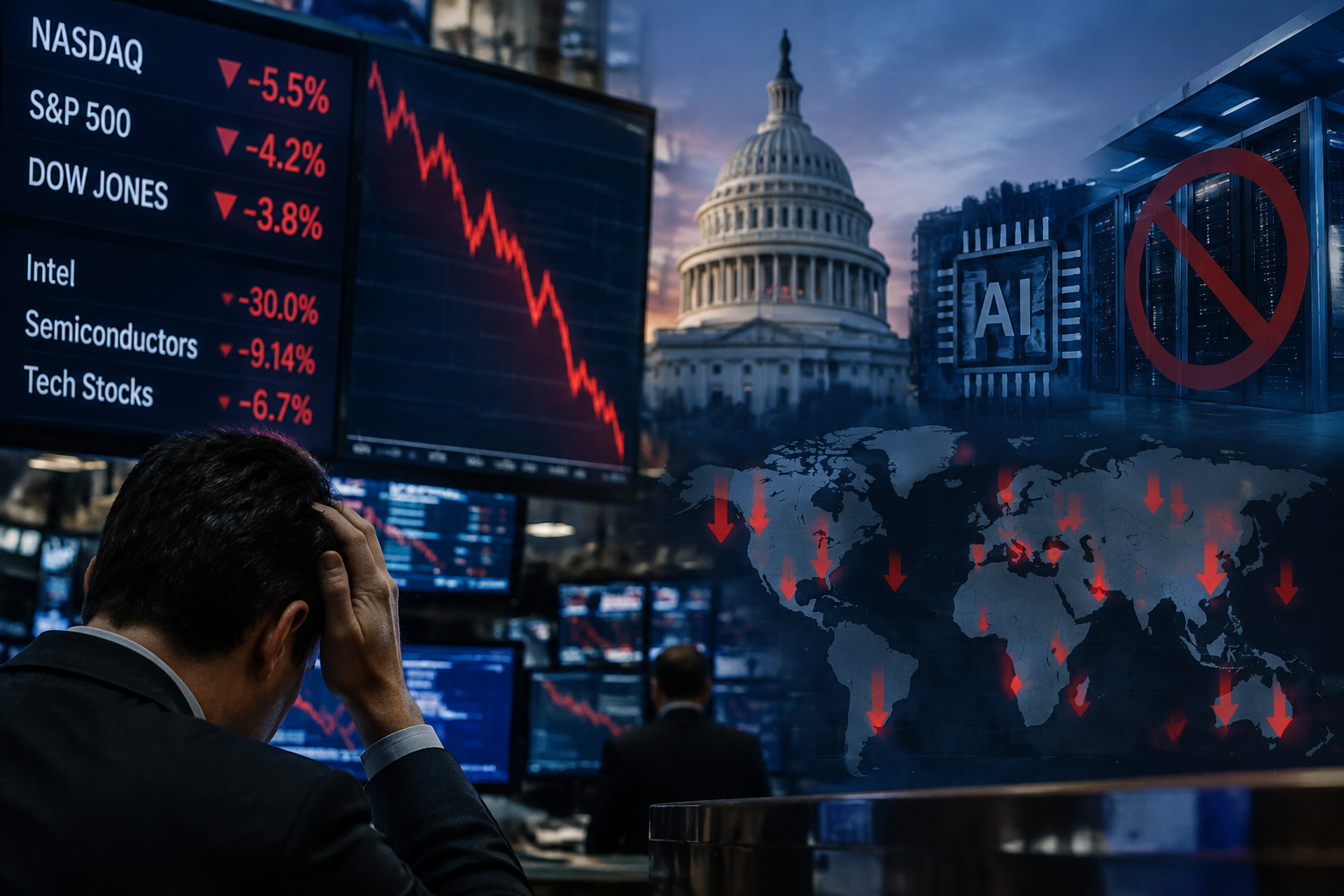
Illustration — For illustrative purposes. · Photo: Vyrio Media / Vyrio Media illustration · Original image source
On November 5, 2026, US financial markets experienced a dramatic sell-off driven by fears over regulatory intervention in the artificial intelligence (AI) sector. The Nasdaq Composite tumbled 5.5%, marking its largest one-day decline since April 2025, and shedding approximately $2.5 trillion in market value. This downturn was largely attributed to investor worries that the Democratic Party's substantial midterm election gains could trigger increased scrutiny and restrictions on AI infrastructure, particularly around the construction of data centers vital to AI development.
Several jurisdictions have already passed measures restricting data center expansions, stoking concerns over the future pace and scale of AI growth. Investors feared that such regulatory measures could hamper the rapid scaling necessary for AI capabilities, pushing markets to reprice tech-related assets accordingly.
Semiconductor companies, crucial to AI hardware infrastructure, bore the brunt of the sell-off. Intel’s shares plummeted 30% following a weak sales forecast across its client computing and AI segments. The Philadelphia Semiconductor Index declined 9.14%, erasing nearly $1 trillion in semiconductor market capitalization in a single day. Broader technology stocks also suffered substantial losses as investors reassessed growth prospects within the AI space under a potentially more restrictive regulatory regime.
The impact of the sell-off extended beyond the United States, hitting global markets hard. Japan's Nikkei and South Korea's Kospi both dropped 6%, with technology stocks among the hardest hit. European indexes also closed lower amid uncertainty, while US futures showed mixed signals in overnight trading.
Financial analysts emphasized that investors are now focused on the evolving political landscape, closely monitoring signals regarding possible regulatory policies on AI infrastructure. The magnitude of the midterm Democratic victories has heightened expectations for enhanced regulatory engagement, which could slow the expansion of AI-related infrastructure investments in the near term.
This market dynamic underscores broad concerns about balancing technological innovation with governance, particularly in fast-evolving sectors like AI. As regulatory frameworks are debated and developed, the financial community anticipates volatility but also looks for clarity that could stabilize investment sentiment.